“Birth Story: Ina May Gaskin & The Farm Midwives” Review
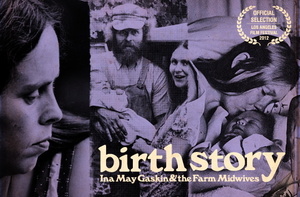
My eyes welled up more than a few times while watching Ina May Gaskin’s new documentary, Birth Story: Ina May Gaskin & The Farm Midwives. I felt emotional throughout, for several reasons, which I’ll explain in this article and review of the film.
Last week, Birth Kalamazoo and Birth Alternatives Midwifery held a benefit screening of the film with proceeds to Friends of Michigan Midwives.
The women behind the scenes making the event happen were my friend and two-time doula, Jessica English, and midwife Linda Healey (who also happened to by my two-time midwife). As SW Regional Coordinator of FoMM, I helped out by gathering silent-auction items from local businesses.
That night, I was surrounded by the energy of 50+ local birth-advocate women and their families. I felt the full room. Safe to say this was an integral factor in my emotional state.
In the film, three natural home births were depicted beautifully, which were woven seamlessly within the story of how The Farm came to be.
Ina May Gaskin was of course a reocurring character. One the audience couldn’t get enough of. We felt lucky to be guests into her past through iconic photographs and film footage of the most famous midwife in the United States. Coming in and out were scenes was her husband, Stephen Gaskin.
And those two lovebirds are the next reason why Birth Story was a big tear-fest. When Stephen said, (paraphrasing) “I’m glad just to be her Sherpa. The Sherpa gets to join you on your way up the mountain.” ?? Enough. said. #meltmyheart
I learned plenty of lessons, some of which I was learning all over again, and some for the first time.
- As always, natural birth is so stunning, it takes my breath away and fills my heart
- Peace and love, and not just in that hippie cliche, (but also that) helps babies come out
- Passion + a good cause + hard work = incredible, life and world-changing results (I want to be like the go-givers in this film!)
- Birth is a normal and natural process
- Women are so f*ing powerful!
- I happen to work best in large groups when I have a task – that night, I sat at the greeting table, accepted donations and re-secured sharpie lids while welcoming each person into the room. I got to say hello to everyone without stumbling drunken-sailor style around the room. Score!
- We need more positive films like this one. Rather than make me mad, I felt inspired and courageous
Make it to a screening of Birth Story or host your own. I highly recommend it. Watch the Birth Story trailer here.
I am a Friend of Michigan Midwives
I recently joined the board of Friends of Michigan Midwives as the Regional Coordinator of Kalamazoo, MI.
Because I believe in this organization and our cause, I’d like to take a moment to introduce you to Friends of Michigan Midwives and what we’re currently working on.
Friends of Michigan Midwives, or FoMM, is a non-profit organization dedicated to educate and inform the public about the Midwifery Model of Care, promote and support the profession of midwifery as well as safe and legal access to out-of-hospital birth for families in the state of Michigan.
We at FoMM support licensing midwives and are currently in the throes of supporting Senate Bill 1310, companion to House Bill 5070, a bill that will license Certified Professional Midwives.
While I’ve only had a handful of opportunities to talk with consumers directly about this bill is important, I’m proud to report each acquaintance has walked away in support of of SB 1310!
Over the next year, I will be hosting several local fundraising events. Keep an eye out, SW Michiganders!
I’d like to take this great opportunity to share why I support licensing midwives with you.
Personally, I am in support of SB 1310 because I know many midwives, doulas and birth advocates have put in countless hours over the past few years crafting it.
When it comes to my health care options, I want to be able to trust the bill in place was written with me in mind, by people who know me. I trust the bill because I trust the women and families who have been working on it’s careful wording. I love knowing my midwife – the woman who helped bring our two precious babies into this world from the safety of our home – will be protected by law with the passing of SB 1310. She currently is not recognized by law, and that makes me feel uneasy.
Licensing makes midwifery an accredited profession attractive to midwives and consumers alike.
Those who are inspired to become a midwife in the future will know their career choice is viable and respected in our state. Licensing will set a standard of training. Right now, Direct Entry Midwives, (DEM) may go through long periods of time without studying the most recent evidence-based practices. While some may be up to date, there is no real way to know.
Midwives who have earned the CPM credential are required to earn continuing education credits, and licensing will ensure that all midwives meet that requirement.
This means a great deal to families interested in finding and hiring a midwife, as licensing CPMs will set into place a trustworthy, respected base of knowledge. I value accountability and training, and take those things into consideration when hiring any care provider whether they be a chiropractor to massage therapist, pediatrician or dentist.
Take action to provide state recognition to midwives and enhance the profession of Midwifery in Michigan today by visiting the official Friends of Michigan Midwives website.
Please click the link to visit their site and learn more and take your own action steps to support licensing midwives. The profession of midwifery in Michigan will grow and this bill will ensure families the right to birth where they choose.
If you feel strongly about this issue and would like to volunteer your time, energy or donate to the FoMM, please email me, (Kaitlin) at [email protected] and we can talk!
Home Birth Advocacy, Pregnancy
The Delicacy of a Woman’s Power During Labor and Birth
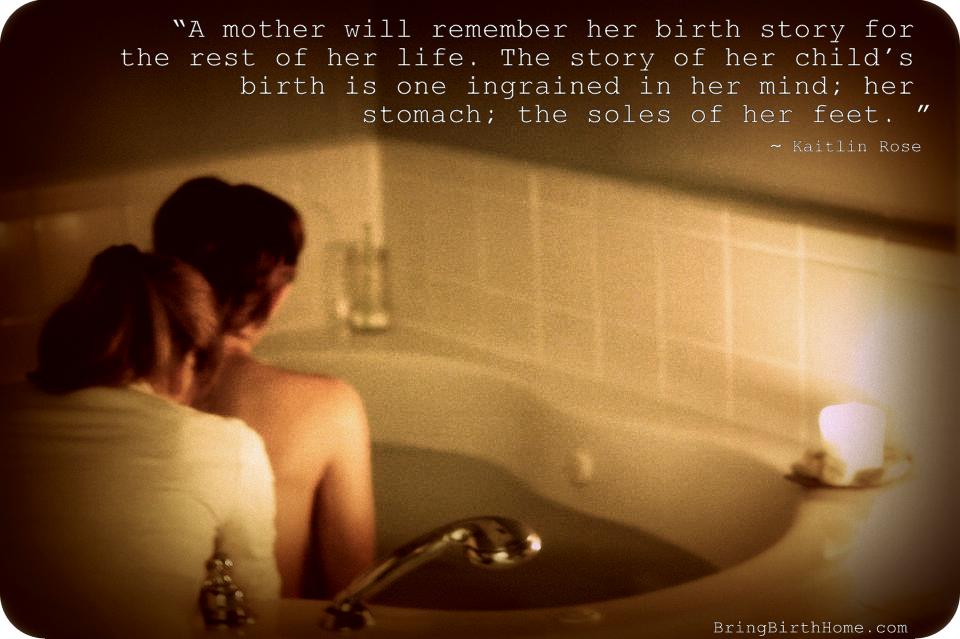
Women have power.
I visualize internal power as a soft glowing ball of light radiating within our chest walls. It can sparkle like the sun in the faces of our friends and warm the deepest crevices. How it feels so invigorating to achieve. Pride in accomplishments. It’s the best.
When you hand over your power, you dim that light. When you hand over your power, you’re giving someone, (who you may deem as more qualified) permission to make important decisions on your behalf.
Whether we shine through or are snuffed out can be in the middle of a “right of passage” moment in life.
Women sometimes find themselves in this position during pregnancy, labor and childbirth. We enter into uncharted territory and might feel nervous about making decisions. Doubts arise. It feels good to have a guide – someone whom you trust to help navigate. This is why I so strongly advocate choosing the right care provider.
The incident might in the moment seem insignificant or minor. A simple assessment phone call during labor to discuss your progress peppered with advice about what to do next. Or feeling the iv cord bump into your thigh with each step. Suddenly feeling irritated and taken out of your “zone.”
During labor, distractions can be downright dangerous.
Each time a laboring woman is distracted, she is pulled from her animal-intuitive brain to her human-thinking brain. Complex thoughts and the actions that follow, as well as near constant monitoring by person or machine, releases adrenaline (this is our fight/flight response). Adrenaline opposes oxytocin, the hormone responsible for contracting the uterus.
As a result of these hormones butting heads, labor slows down. Due to this “failure to progress,” further interventions might be “needed” to induce labor, speed up labor, alleviate pain from overly powerful contractions due to induction and/or augmentation, and in some cases, cesarean section.
A woman just lost her power.
Keep your inner light lit by dreaming up and planning for a beautiful birth experience. Build a birth team filled with support. Don’t save the space for distractions and interference (at an absolute minimum). Stay away from negative press and conflicting philosophies that your feel might compromise your experience , during pregnancy, labor, birth and postpartum.
Start with trust.
Labor and birth is for a woman the process of letting go and going in, if we allow it. Trust your Self, your body and of course, birth and the entire life cycle.
That is a lot to trust, and to have faith in. You are a lot to have faith in. I know from experience it can be hard to call yourself “worthy” of your own time and respect. But you are. No matter what you’ve done, or what kind of challenge you think you can’t endure, you are human mother giving birth to a human baby. And that is a normal physiological, yet utterly amazing event in our lives!
Looking for more empowered birth posts? These topics relate:
There is Light at the End of the Birth Canal
Your Amazing Newborn | Book Review
Your Amazing Newborn is the first book I’ve read of my DONA postpartum doula training reading list.
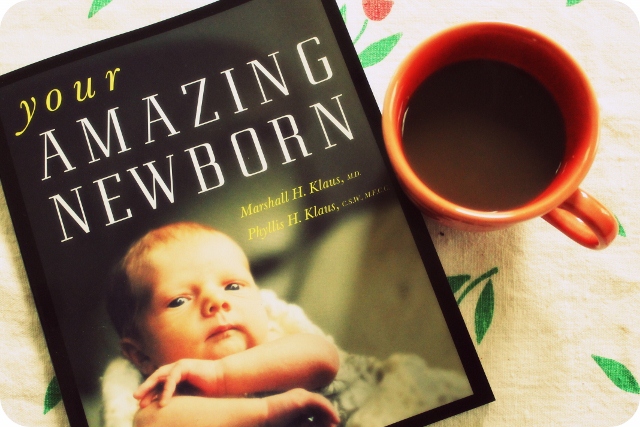
The book was short at 114 pages but is packed full of extremely useful and fun-to-know information.
Our education actually begins before baby is born with Chapter One, Before Birth: Dawning Awareness. I learned so much about how precious little beings can express themselves in the womb; can taste, suck their thumbs early in life and recognize the sound and smell of their mother.
There are several studies cited in Your Amazing Newborn.
Each fact is backed up by a study. For instance, newborns respond to their mother’s voice. Similarly, mothers can pick out their baby’s cry from a group within a few days of birth. This one blew my mind – newborns sometimes smell like a spice their mother ate days before giving birth. Amazing!
Another aspect I liked about the book is it’s gentle lean toward attachment parenting and mentions newborn bonding frequently.
Chapter Two, The First Minutes, has a beautiful photo sequence of a newborn crawling to the breast to self-latch. In fact, this book is peppered with great images of newborns and their families on nearly every page. I loved looking at the photos as much as reading the text.
Chapter Eight, Expressions and Emotions was one of my favorites – Newborns are very expressive indeed! They can mimick our faces at a very early age. But newborns tire out quickly, and the authors are good to remind us to let our babies rest and not to overstimulate.
I would recommend this book to any parent – whether they have children or are first time parents – because it’s easy to handle. The information presented isn’t overwhelming and has a nice balance between being scientific and thoughtful without boring us to death.
One down, three to go. Stay tuned for more book reviews in the coming weeks!
Beautiful Home Birth Photos
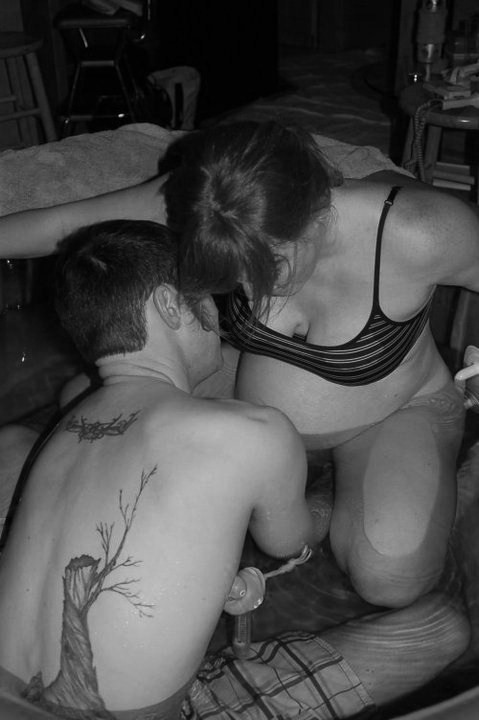
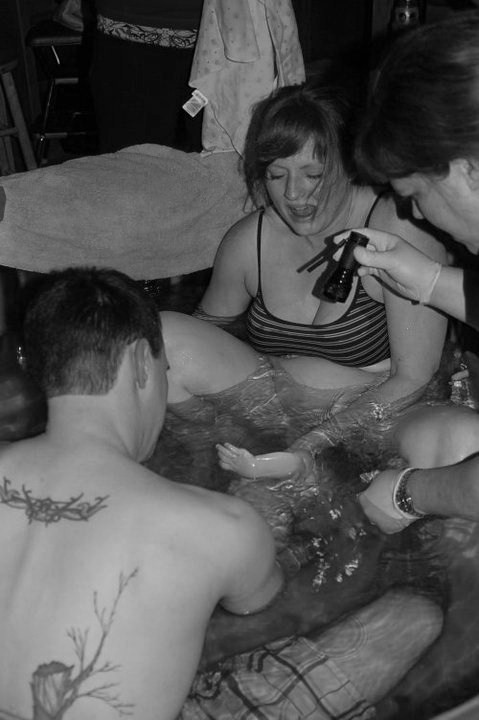
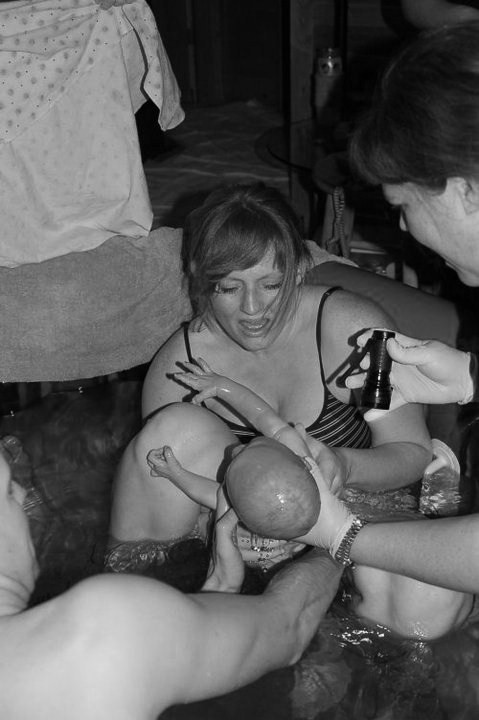
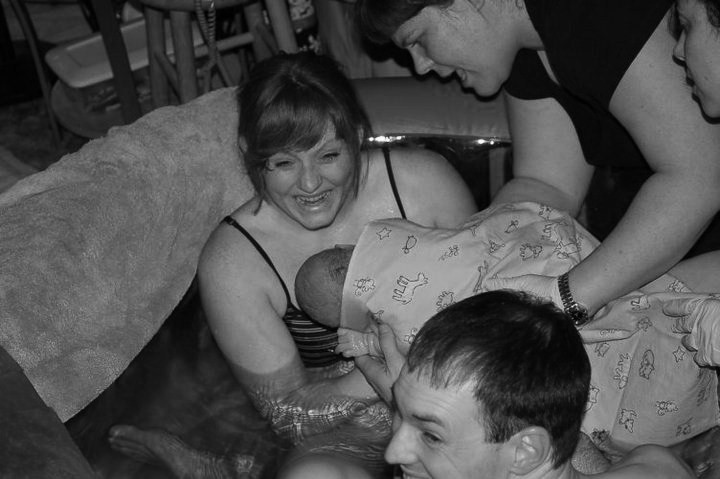
Thank you to the Cole family for sharing your photos with us!
There is Light at the End of the Birth Canal

It has been said that the hardest part of the journey takes place right before the breakthrough or transformation.
This is the position in which I see childbirth in the United States and around the world.
Everywhere, there are uprisings. People taking to the streets, reclaiming their power, strengthening their resolve, beckoning with their voices. No matter where, or what the reason, there is a similar tune: freedom.
Tonight I was part of a viewing of Freedom For Birth, a documentary film by One World Birth, and sat on a panel discussion after the film.

The entire event was exhilarating for me to be a part of. Although I had already seen the film earlier this week to prepare for the panel discussion, the depth in which I appreciated it’s content was just as, if not more, powerful as I’d felt watching for the first time.
Freedom For Birth is a film that will outrage you, that is for sure. The statistics and stories told from around the world about the abuses to women during childbirth are completely unacceptable.
But the film is also incredibly inspiring in that one can answer with confidence that change is not only necessary, I’ll go as far to say it’s on the horizon.
We’ve hit the bottom of the abyss. (I’m paraphrasing Michel Odent said in the film.) His statement is followed by this question, written out for us on the screen: How do we climb out of the abyss?
The same way our children come into the world. Pushing against what feels like nothing, twisting and turning, feeling stuck and then moving another inch. Sometimes backward an inch too. Yet all while, on some deep instinctual level, we are moving forward toward the light.
Our journey to reclaiming birth as a fundamental human right will be long and hard. But there is a very bright light at the end of the tunnel. That light signifies freedom. As long as each person who believes in birth lets their voice be heard – on a micro and macro level – there is nowhere to go but upward.
My final message is in these few action steps you can take to #1, ensure you have a choice in creating your ideal birth experience, and #2, how women and families can take back the power of childbirth.
- Have a vision for your birth. Dream about your birth. Draw your birth. Meditate over your birth. What does it look like? How do you want to feel? What is the best way to bring your baby into this world?
- Find the right care provider. I’m talking the perfect fit. You must know like and trust that person with all your heart and know your entire gut instinct says they are the one. Interview as many as you need to.
- Share your positive pregnancy experiences and empowering birth stories with everyone you can. The world needs to hear about beautiful births. The balance is currently tipped in the favor of negative and fear-based tales. Let’s change that!
- Get involved on a local, statewide, and even a national level to help change the conversation in a positive direction. What organizations can you become a part of? For me, it’s FoMM, and attending screenings like the one tonight (and BBH of course!).
I’d love to hear from you in the comments below. What action steps do you think we can take as a nation, or as a planet of human beings, to change the culture of birth for the better?